
How to Use the Periodic Table to Memorize Less in Chemistry
Jump to a topic
Build your own table“Am I really supposed to memorize all of this?”
Element names. Symbols. Charges. It can feel like every chemistry lesson adds another list to remember.
Before you try to memorize each fact separately, take a closer look at your periodic table.
I tell my students I want to show them how to use that table so they don't have to memorize so much chemistry. There's a lot of help on that page once you know where to look.
Some information is printed right in an element's box. Other clues come from where that element sits. Learning a few patterns can help you work out answers for several elements.
We'll walk through the table in the same order as my Periodic Table Decoder, adding one useful layer at a time. You'll see completed examples, and I'll point out what to look for in each one.
You'll still need to practice. But you won't be trying to remember every fact as a separate piece of information.
Grab the periodic table your class uses. If your instructor provides one for exams, practice with that version so you know what information you'll have.
Let's start with one box: magnesium.
What do the numbers in an element's box mean?
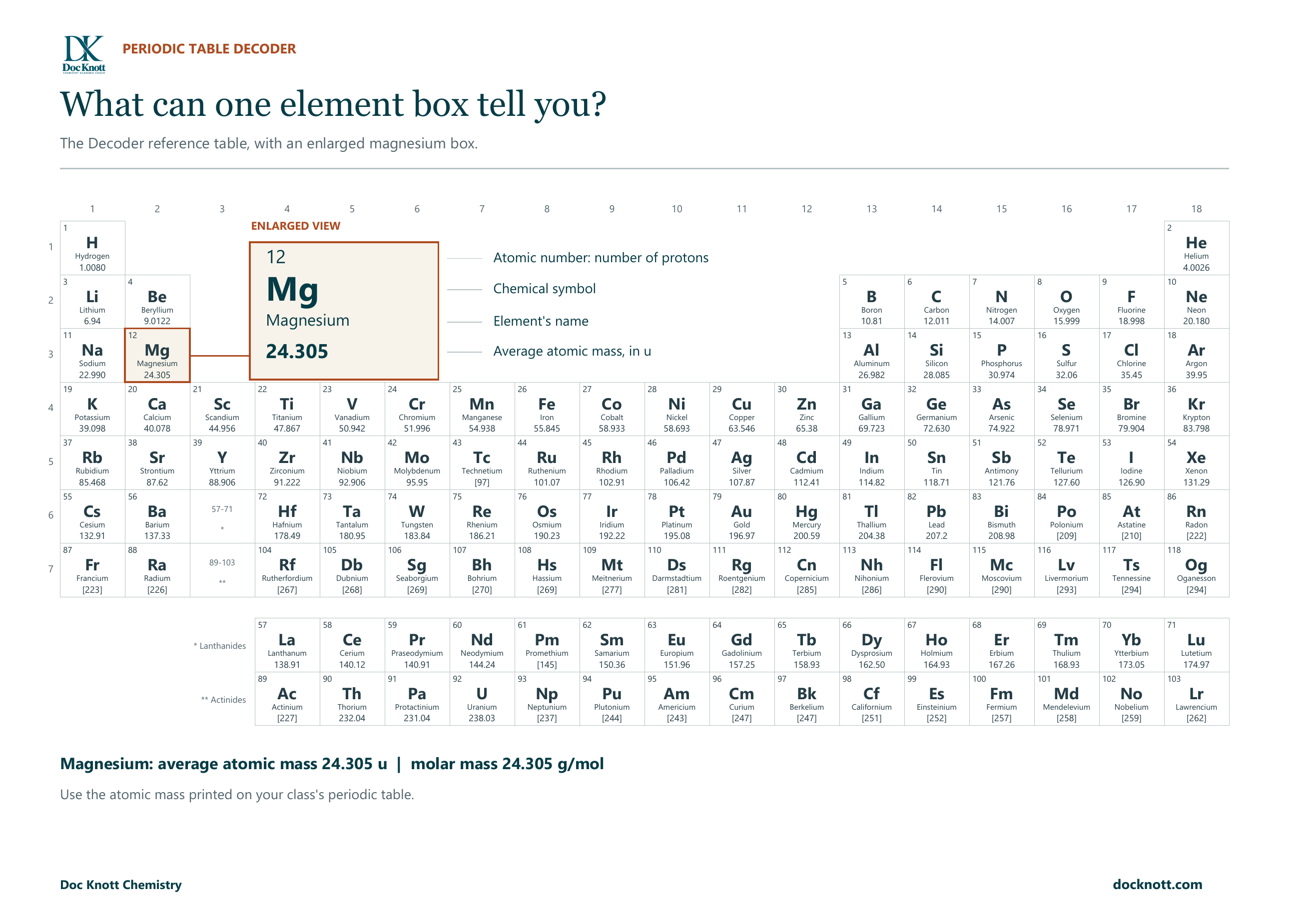
Find magnesium in the table, then look at its enlarged box.
Start with 12. That's the atomic number. It tells you magnesium has 12 protons. If the atom is neutral, it also has 12 electrons, because the positive and negative charges balance.
Mg is its chemical symbol. Underneath, you'll see its name: magnesium.
Now look at 24.305. That's magnesium's average atomic mass, measured in atomic mass units, written as u.
That same number helps when you're working with moles. The numerical value becomes the molar mass, with different units:
Average atomic mass: 24.305 u
Molar mass: 24.305 g/mol
So one mole of magnesium atoms has a mass of 24.305 grams.
You don't need to memorize that number. Find magnesium, read the mass, and use the units your question calls for. If your class's table gives a different number of digits, use the value on that table.
If you'd like a refresher on what a mole means, this guide explains moles, grams, and how they're connected.
One term we'll use when reading the table: ion. An ion is an atom or a group of atoms with an overall electric charge. Losing electrons makes an atom positive; gaining electrons makes it negative. Our charge map will show ions made from one atom.
That's useful information from one little box. Now look at where magnesium sits on the table. Its column gives us another clue.
What are groups and families on the periodic table?
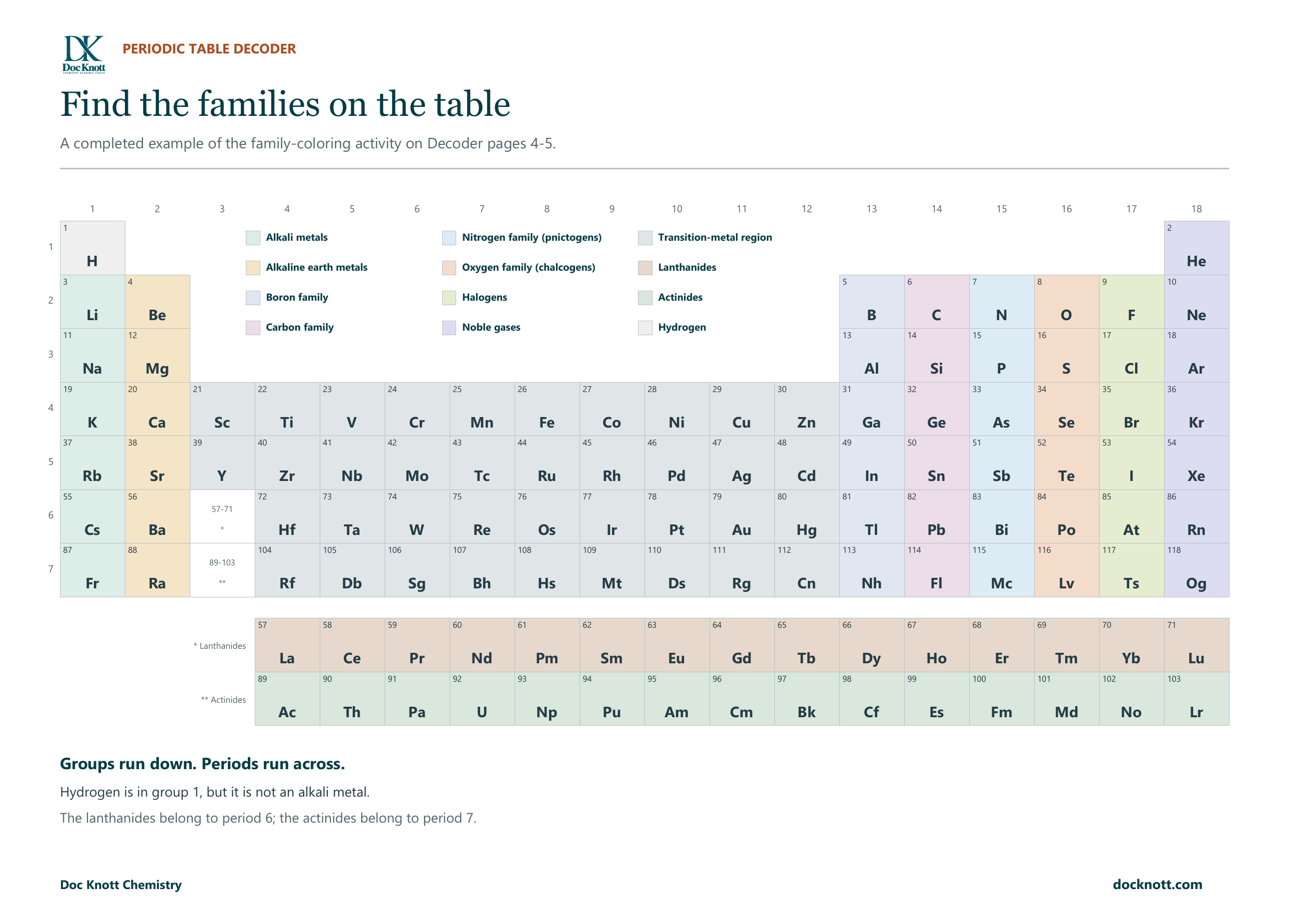
Find magnesium again. Follow its column down to calcium, strontium and barium. They're all in group 2, the alkaline earth metal family.
The vertical columns are called groups. The horizontal rows are called periods. Magnesium is in group 2, period 3.
Here's why the columns are useful: elements in the same group often behave in similar ways. Once you learn a pattern for that family, you've learned something useful about several elements. You don't have to start over with each one.
Look near the right edge. Fluorine, chlorine, bromine and iodine belong to the halogens, in group 17. One column farther right, you'll find the noble gases, in group 18. The color key names the other families, too.
The wide section in the middle is the transition-metal region. The two rows below the main table are the lanthanides and actinides, commonly called the inner-transition elements. They belong in periods 6 and 7. They're pulled below the table so it fits more easily on a page.
One detail to notice: hydrogen sits in group 1, but it isn't an alkali metal. That's why it has its own color here.
Try finding calcium on your class's table. Even without these colors, can you identify its group, period and family?
Now let's use the table to tell metals from nonmetals.
How can you tell whether an element is a metal or a nonmetal?
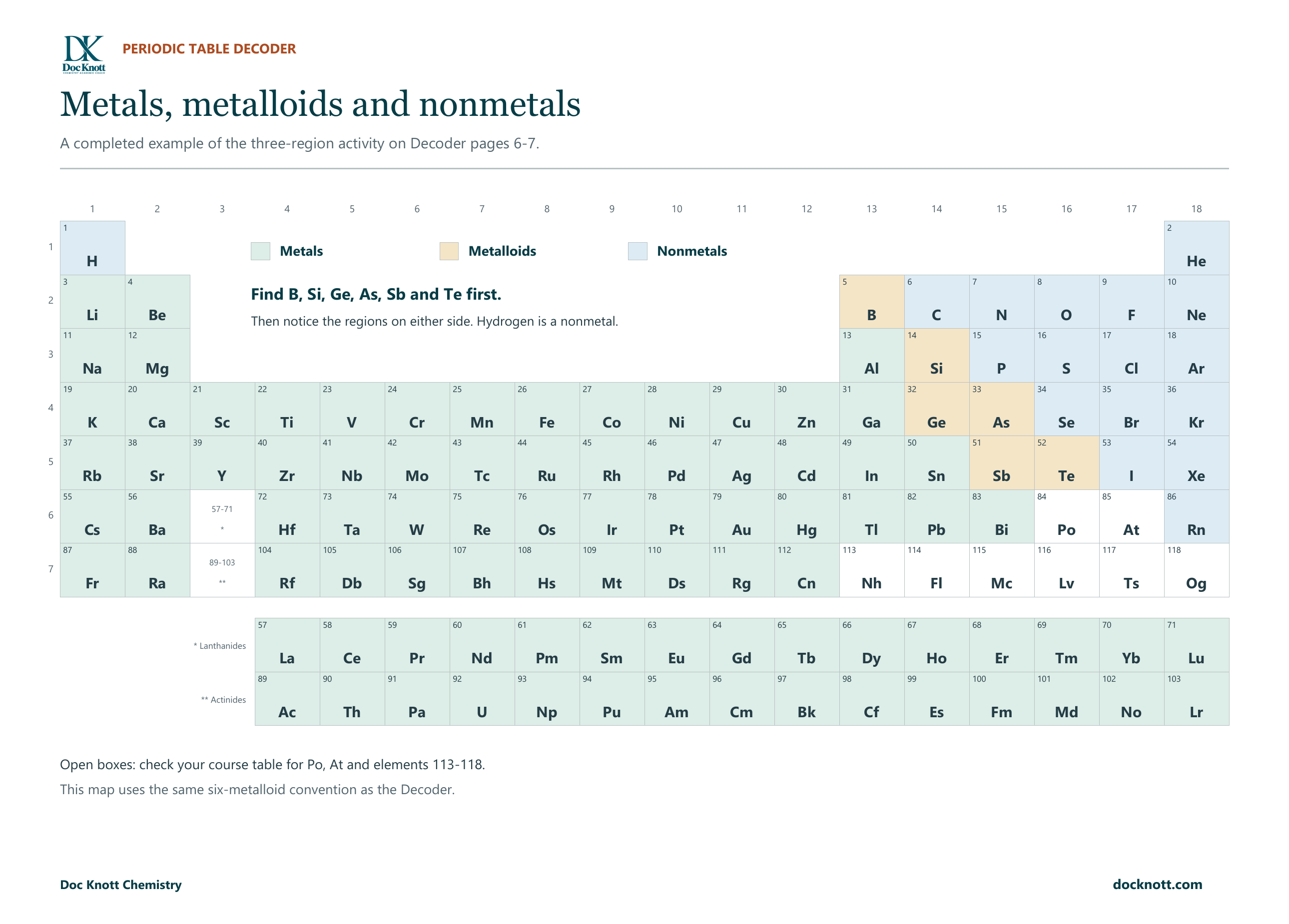
Start with the six gold boxes: boron (B), silicon (Si), germanium (Ge), arsenic (As), antimony (Sb) and tellurium (Te).
These are the metalloids we're using in the Decoder. They have some properties of metals and some properties of nonmetals.
Follow those boxes down the table. See how they mark a boundary?
The green region contains the metals. The blue region contains the nonmetals. Most metals sit to the left of that boundary; most nonmetals sit to the right.
Now find hydrogen. It's on the far left, but it's blue. Hydrogen is a nonmetal.
Learning where those six metalloids sit gives you a useful shortcut. You can use that boundary to recognize the larger regions, even when your table isn't colored.
Try finding aluminum and sulfur on the map. Which side of the boundary is each on?
Aluminum is a metal; sulfur is a nonmetal.
The uncolored boxes are left open in the Decoder for checking against your course's table. Different tables may also use different colors, so always check the key.
What do the s, p, d and f blocks tell you?
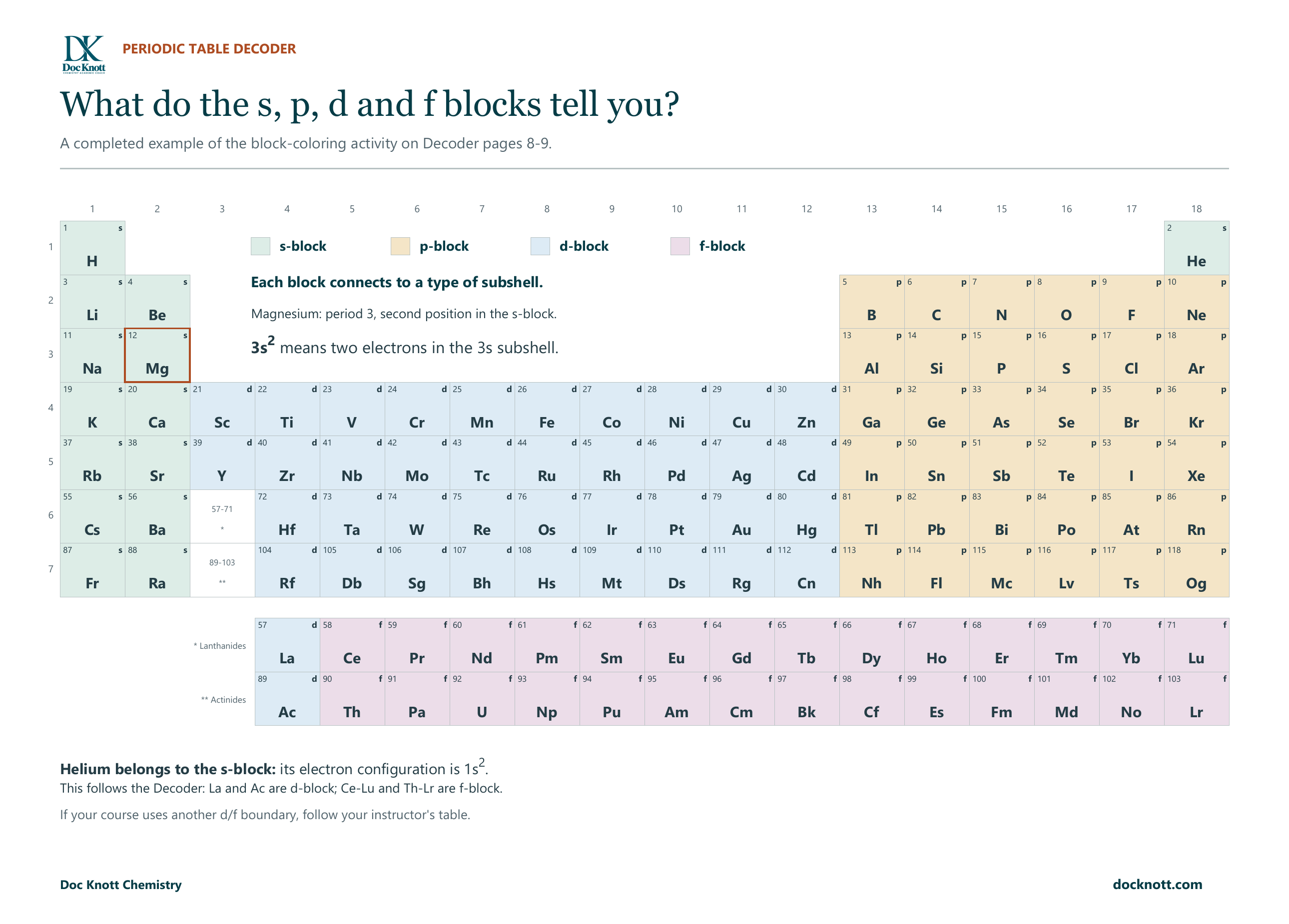
These letters name types of subshells: parts of an atom's electron arrangement. Each block connects to the type of subshell being filled across that region.
Look at the four colors:
s-block: the first two columns, plus helium.
p-block: the six columns on the right, except helium.
d-block: the blue middle region, with La and Ac included in this Decoder.
f-block: the pink portion of the two detached rows.
Here's a small example of how that helps. Find magnesium. It's in period 3, in the second position of the s-block. Its electron configuration ends in 3s².
The 3 tells you the main energy level. The s names the subshell. The raised 2 tells you there are two electrons in that subshell.
You worked that out from magnesium's position on the table.
Now look at helium. It sits with the noble gases, but it's colored as s-block. Its two electrons are in the 1s subshell, so its electron configuration is 1s².
If electron configurations are part of your course, these blocks help you build them. OpenStax has a fuller walkthrough, including the exceptions.
How can you use the periodic table to predict an ion’s charge?
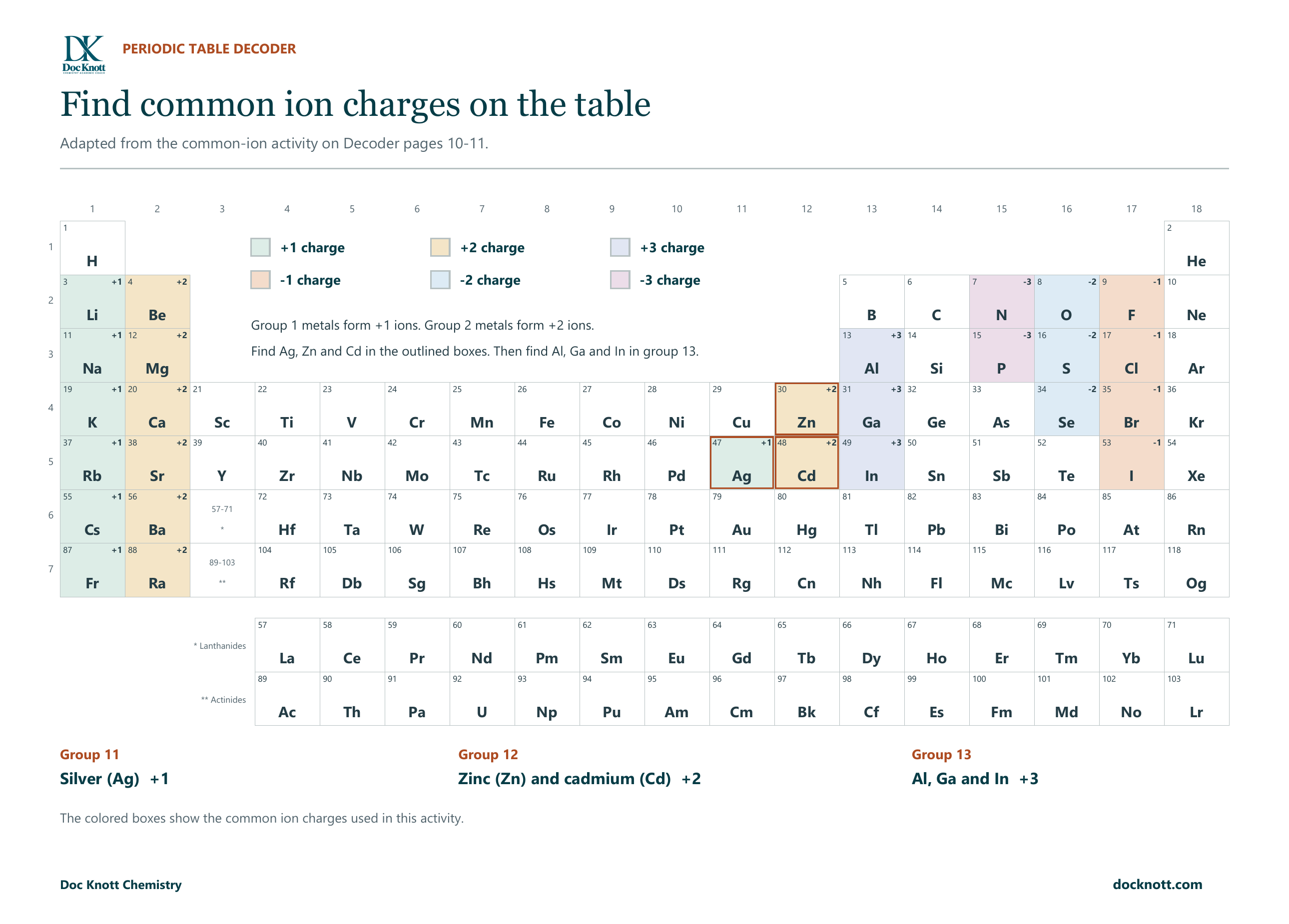
Start with groups 1 and 2. Put your finger on lithium and follow group 1 down. The metals in that column form +1 ions, like Na⁺ and K⁺. Move one column to the right. The group 2 metals form +2 ions, like Mg²⁺ and Ca²⁺.
Now find the three outlined boxes. Many metals in the middle of the table can form ions with different charges. Silver, zinc and cadmium are three exceptions I ask my students to remember. The column numbers give you a way to remember their charges.
In group 11, silver forms Ag⁺. Same +1 charge as the group 1 metals.
In group 12, zinc and cadmium form Zn²⁺ and Cd²⁺. Same +2 charge as the group 2 metals.
One column farther right, in group 13, you’ll see aluminum, gallium and indium shaded together. Their common ions are Al³⁺, Ga³⁺ and In³⁺.
Two other metals I ask students to remember are tin (Sn) and lead (Pb). They’re in the main group, and both can form ions with different charges. For those two, you’ll need another clue in the problem to know which charge to use.
For many main-group elements, you can work out the charge by counting to a nearby noble gas. Try it with chlorine in group 17. A neutral chlorine atom has 17 electrons. Move one box to the right and you’re at argon, which has 18. When chlorine gains one electron, that extra negative charge makes it a chloride ion, Cl⁻.
Cl⁻ and Ar now have the same number of electrons. Chemists call them isoelectronic.
Keep your finger on argon and look back along that row. Sulfur, in group 16, is two boxes away. It gains two electrons to form S²⁻. Phosphorus, in group 15, is three boxes away. It gains three electrons to form P³⁻. All three ions have 18 electrons, just like argon.
Try it on your class’s table. Find bromine. How many electrons would a neutral bromine atom need to gain to match krypton?
One. That gives you Br⁻, the bromide ion.
How can you estimate effective nuclear charge from the periodic table?
Picture yourself in the front row at a rock concert. The people beside you barely affect your view of the band. Now move back five rows. The people standing between you and the stage make a much bigger difference.
I use that picture when I teach shielding. Imagine the nucleus is the stage and you’re an outer electron. Electrons in the inner shells, called core electrons, screen some of the nucleus’s pull. Electrons beside you in the same shell do a little screening, too. The positive nuclear charge you effectively feel after that screening is called effective nuclear charge, or Z-eff.
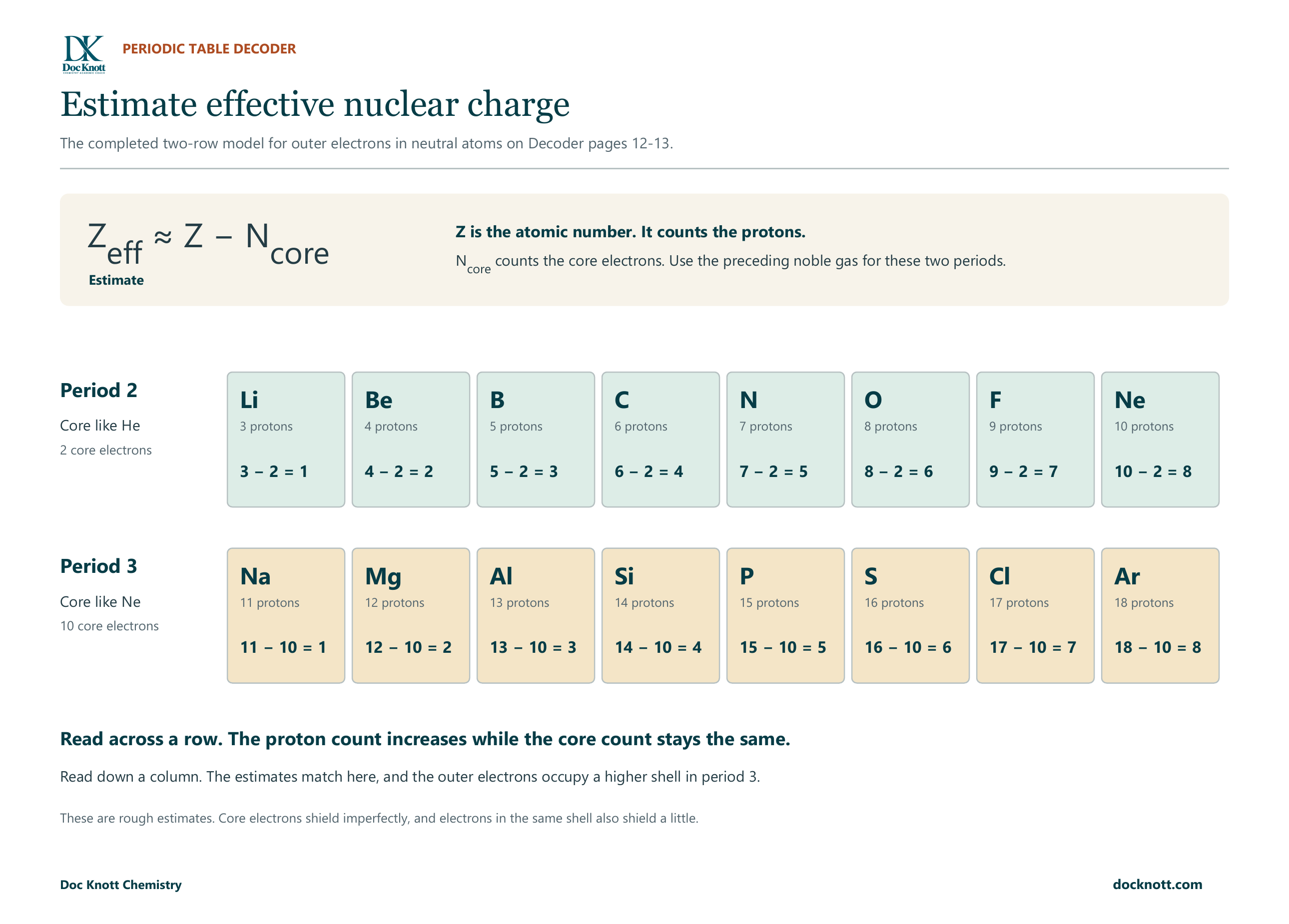
Find sodium (Na) in the bottom row. Its atomic number tells you it has 11 protons. To estimate Z-eff, subtract the number of core electrons. Where do you find that number? Look at neon, the noble gas just before sodium. Neon has 10 electrons, and sodium has that same 10-electron core. Our estimate is 11 − 10 = 1.
Now slide one box to magnesium. It has 12 protons and the same 10 core electrons, so the estimate rises to 2. Follow the row with your finger. Each step adds a proton while the core count stays the same. You can see the same pattern in period 2, where the core is the two electrons of helium.
Now read down from lithium to sodium. This simple model gives both an estimate of 1. But sodium’s outer electron occupies a higher shell, farther from the nucleus. That distance matters, too. It helps explain why a sodium atom is larger than a lithium atom. OpenStax explains how shielding and distance affect atomic size.
Put your finger on sodium and slide across to chlorine. In both atoms, the outer electrons are in the third shell. Both have the same 10 core electrons, but chlorine has six more protons pulling on its electrons. Which atom would you expect to pull its outer electrons in closer?
How can you use periodic trends to compare two elements?
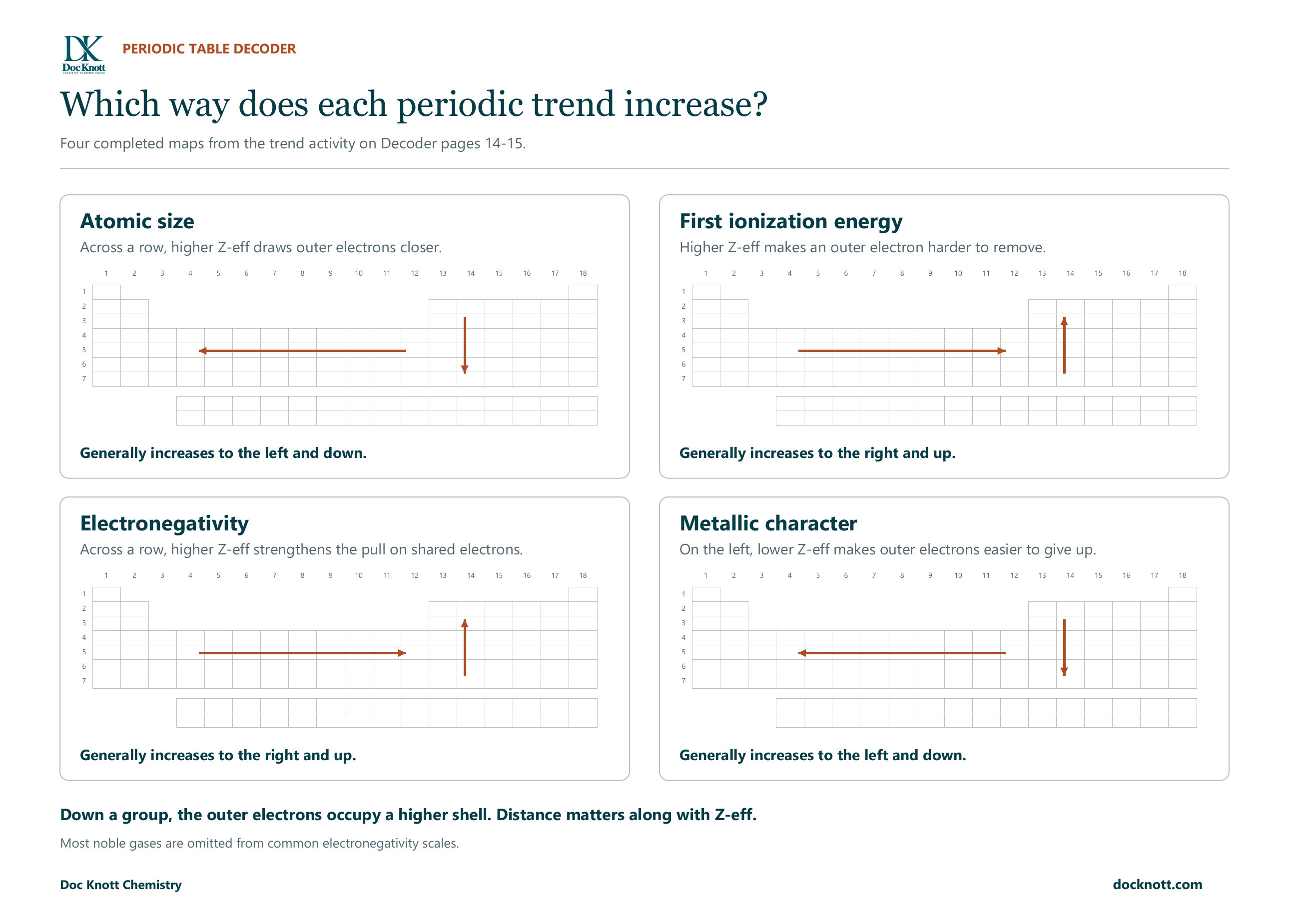
Chlorine pulls them closer, so a chlorine atom is smaller than a sodium atom. You just used the periodic table to predict atomic size. Sodium and chlorine both have their outer electrons in the third shell. Chlorine has six more protons behind the same ten core electrons. Its outer electrons feel a higher effective nuclear charge (Z-eff), which draws them closer to the nucleus. That’s why atoms generally get smaller as you move right across a row.
First ionization energy. Keep your finger on chlorine. If its nucleus holds an outer electron more tightly, will that electron be easier or harder to pull away? Harder. That same higher Z-eff helps explain why removing the first electron takes more energy for chlorine than for sodium. First ionization energy is the energy it takes to remove one electron from a neutral atom in the gas phase. More on atomic size and ionization energy.
Electronegativity. Slide one box left from chlorine to sulfur. Imagine those two atoms sharing a pair of electrons in a bond. Which atom pulls harder on that pair? Chlorine. Its higher Z-eff and smaller size help it attract the shared electrons more strongly than sulfur does. That pull on shared electrons is what electronegativity describes. More on electronegativity.
Metallic character. Go back to sodium and move one box right to magnesium. Sodium’s outer electron feels a lower Z-eff than magnesium’s outer electrons, so sodium gives up its first electron more easily. That tendency to give up electrons is one way we recognize metallic behavior. It helps explain why metallic character generally increases as you move left across a row.
Try a column this time. Find fluorine and chlorine. Our simple model gives an outer electron in each atom the same Z-eff estimate of 7. Which atom is larger? Which pulls harder on shared electrons?
Chlorine is larger. Its outer electrons occupy the third shell, a shell farther out than fluorine’s. Fluorine is smaller, so shared electrons can get closer to its nucleus and feel a stronger pull. That’s why fluorine is more electronegative.
How do you remember the seven diatomic elements?
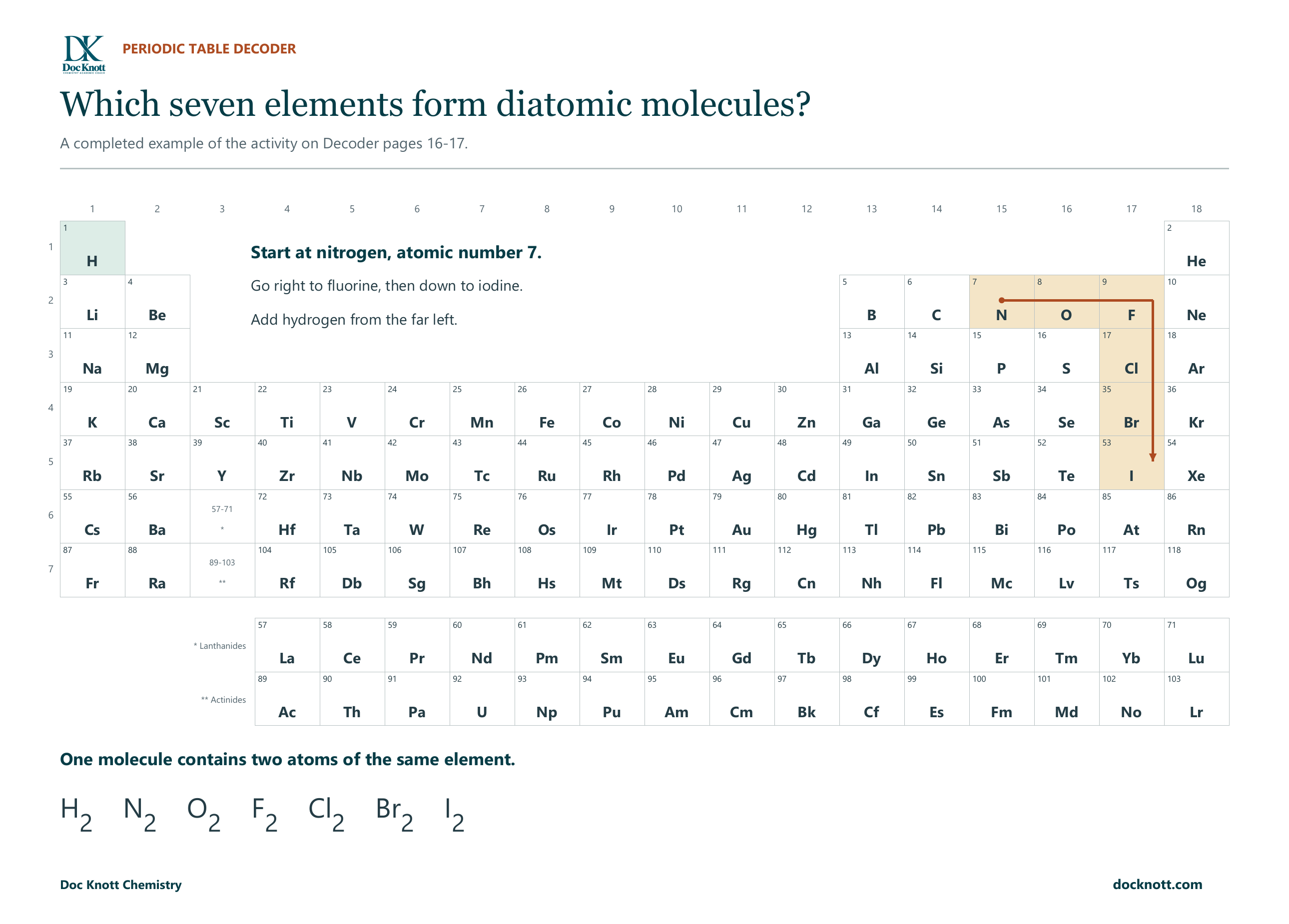
If a chemistry problem says oxygen gas, what do you write? The periodic table gives you the symbol O. In oxygen gas, two oxygen atoms bond together to form one molecule, so you write O₂. A molecule made of two atoms is called diatomic. More on reading chemical formulas.
Find nitrogen, atomic number 7. Put your finger on N and trace a 7 on the table. Go right through N, O, F. When you reach fluorine, turn and go straight down through Cl, Br, I. Count the boxes you touched. That’s six. Where’s the seventh? Hydrogen, all the way over on the left.
You can now write all seven elemental formulas by tracing the shape and adding hydrogen. They’re H₂, N₂, O₂, F₂, Cl₂, Br₂ and I₂.
Try it on your class’s table. A problem mentions solid iodine. Find iodine at the tip of the 7. What formula would you write?
I₂. If you’re also asked to show its physical state, write I₂(s). The little 2 counts the atoms in one molecule. The (s) tells you it’s a solid.
Which elements should you practice remembering first?
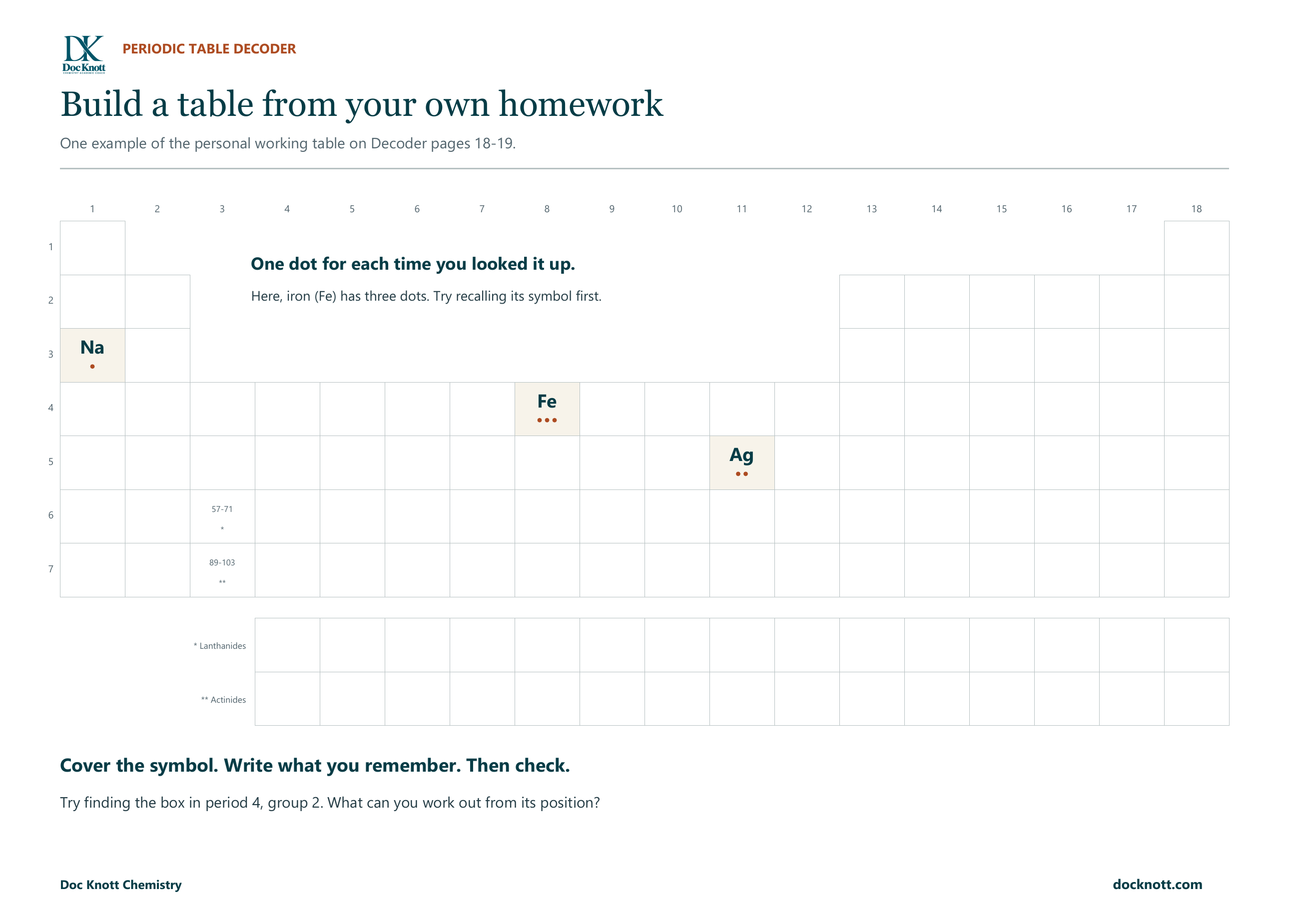
Keep a blank periodic table beside you the next time you do chemistry homework. Say a problem mentions iron and you have to look up its symbol. Find iron on your reference table, pencil Fe into the matching box on your blank one, and put a dot beside it. If you have to look it up again, add another dot.
In the example, iron has three dots. That’s the one I’d practice first. Cover the symbol, write what you think it is, then uncover it and check. Give it another try tomorrow. Your own homework will show you which element to add next.
One last question. On the table your class uses, find the element in period 4, group 2. What’s its name and symbol? Which family does it belong to, and what charge would you expect its ion to have?
The box gives you calcium, Ca. Its column tells you it’s an alkaline earth metal, and the group 2 pattern gives you Ca²⁺. You read the name and symbol, then worked out the rest from where calcium sits. That’s how I want you to use your table when a new problem lands in front of you.
Work through the Decoder with me live
Bring the periodic table you use in class. On Tuesday, November 10, at 6 p.m. Pacific (9 p.m. Eastern), I’ll have my Periodic Table Decoder under the document camera on YouTube. We’ll work through it page by page. I’ll show you how to write a full electron configuration from the table and how counting over to a noble gas can help you predict an ion’s charge. Bring a question from class and we can work through that, too.