
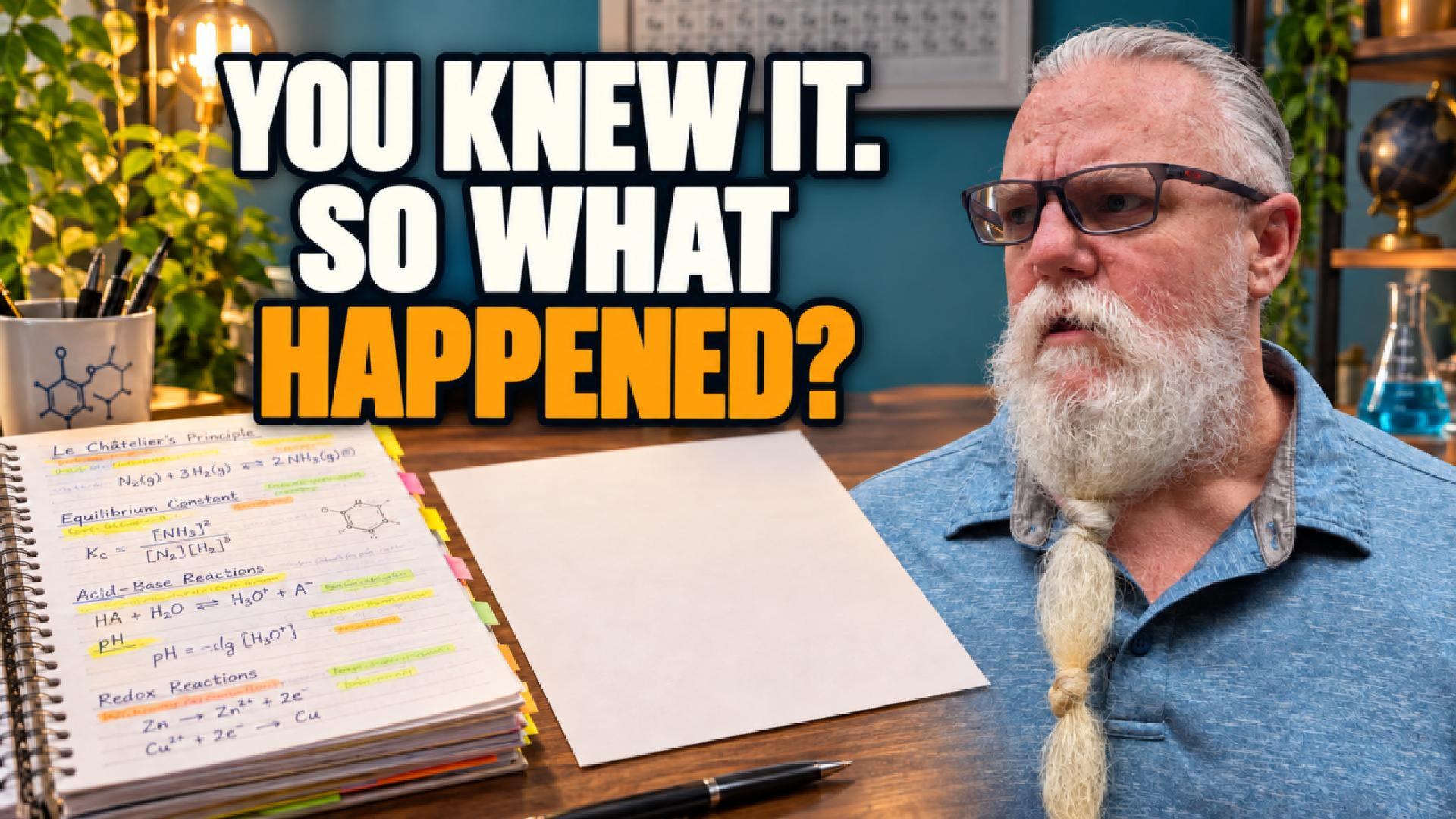
They Understand the Homework. So What Happens on the Chemistry Test?
You saw your student working. The homework got done. They told you the examples made sense. Then you saw the chemistry test and wondered what happened.
How could they understand it yesterday and struggle with it today?
Your student may be asking the same question. They might even tell you, “I forgot everything.” One score doesn't prove they didn't try, and getting stuck doesn't erase what they already learned.
Here's one possibility worth checking: following an explanation and choosing the steps on your own are different jobs. Your student may have practiced one much more than the other.
It isn't the only reason a test can go badly. But before asking them to study the whole chapter again, we can look for something more specific. Here's a practice routine you can read together—or let your student try on their own.
Why a worked example can feel easier than a test problem
When you watch a teacher solve a problem or follow the steps in your notes, the information is already there. You can recognize the idea, see why a step makes sense and think, Yeah, I know this. That understanding matters. The example did help you learn.
But on a test, the example is gone. You have to retrieve the idea, decide which relationship fits, choose a first move and get your thinking onto paper. If those decisions were always supplied by a video, notes, a helper or the worked example itself, you may not have practiced making them yet.
Think about riding somewhere while another person drives or the GPS tells you every turn. The streets look familiar. Then you try to drive the route alone and can't remember which turn comes next. You recognized the route; you hadn't practiced choosing it.
A fresh chemistry problem works the same way. Knowing why someone else's step was correct is valuable. Choosing that step yourself, without their answer beside you, takes practice.
Try one fresh problem in exam mode
Before you call a study session finished, choose a problem you haven’t just seen worked out, on material you've been learning. Put away the notes, videos, answer key and worked examples you won't have during the test. Keep the tools, reference sheets and accommodations your actual exam allows. Exam mode means practicing under the right conditions, not taking away support you're entitled to use.
Then work through this sequence:
Explain what you know. On a blank page, say one important idea in your own words, as if you were teaching someone who isn't there.
Try a fresh problem. Before calculating, say what the question asks, what information you have and what relationship or first step you think you need.
Make an attempt and notice where you stop. Write what you can. If you get stuck, mark the first decision you couldn't make. You don't need to sit there getting more frustrated to prove you tried.
Check your work and mark the first gap. Did you forget an idea? Could you name the relationship but not decide whether it fits? Did the setup or units stop you? Could you finish but not tell whether the answer makes sense?
Start by repairing that gap. Reopen the explanation you need for that part, or ask someone to explain it. Then put it away and try again. Follow with a different problem on the same idea to check whether you can choose the steps—not just remember the answer.
The fresh problem might make you feel less prepared than rereading the notes did. That's uncomfortable, but it gives you information you can use. “I don't know chemistry” is enormous. “I couldn't decide which relationship to use” is small enough to practice.
Use F.O.C.U.S. to name the first stopping point
In the full lesson, I use the F.O.C.U.S. Method to make that stopping point more specific:
F — Find the gap: What is the first part you don't remember or can't use yet?
O — Organize: What does the problem ask for? What do you have and need? For a calculation, what would a reasonable answer look like?
C — Connect: Which idea, formula or relationship connects what you have to what you need?
U — Use the information and Units: Set up the work, then check the units before trusting the calculator.
S — See if it makes sense: Does the answer fit your prediction? Can you explain why you did what you did?
These aren't five boxes to check once. If the units reveal a broken setup or the answer doesn't make sense, go back to F and find the new gap. The point isn't to make every problem painless. It's to know what to work on next.
What a parent can do without taking over
If your student says, “I studied, but I couldn't do it on the test,” try not to turn one score into a verdict about effort or intelligence. Ask them to attempt one fresh problem with the notes closed, then watch where the work stops.
Give them room to choose the first step. If you supply that step immediately, you may learn that they can follow your route, but not whether they can choose one on their own. When they stop, ask: “What do you know so far, and what couldn't you decide next?”
That answer may point to the smallest part they need to practice—or get help with. It is a better starting place than “Study the whole chapter again.” Over time, the aim is for your student to ask those questions themselves.
I measure success by how confidently your student works without me.
The check before you say “I'm done studying”
Ask yourself two questions:
Can I explain what this new problem is actually asking?
Can I start and work through it without the example or another person choosing the steps for me?
If not, you have found something specific to practice before the exam. If you can, check the work and try another fresh problem when you need more evidence. Time spent studying matters, but the ability to retrieve, choose, work and check without the help in front of you tells you something different.