
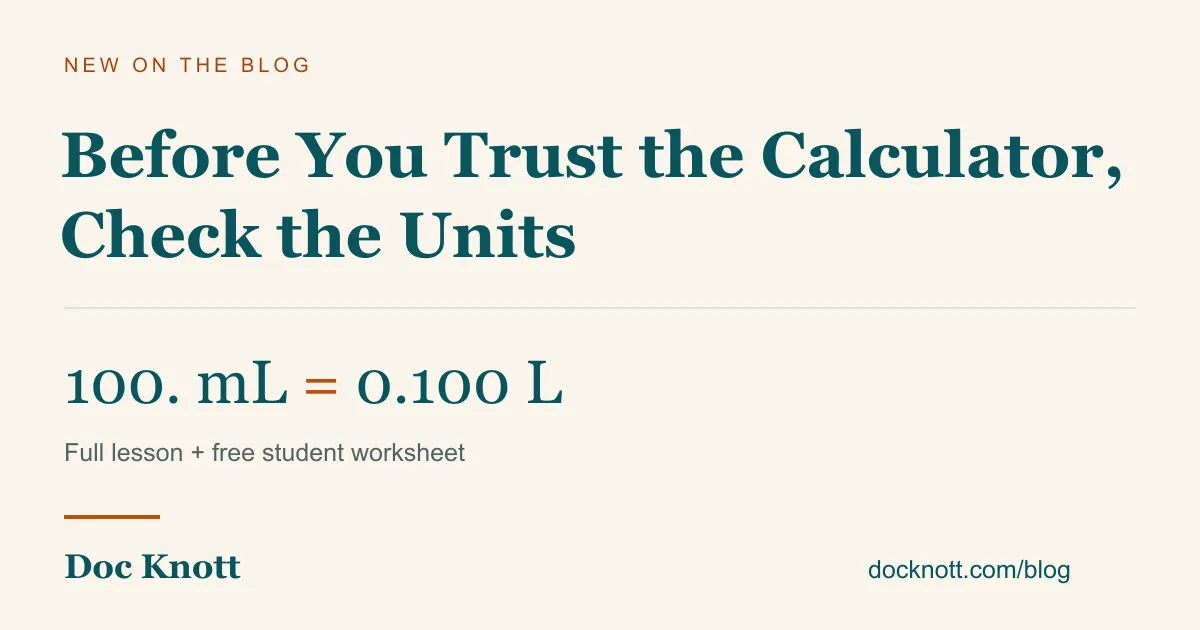
Before You Trust the Calculator, Check the Units
By Doc Knott · Chemistry Academic Coach
Watch and practice
The worksheet follows the full lesson. Use it as you watch, with room to set up the problems and check your own work.
Watch the full lesson
Download the free student worksheet
Your student types the numbers into a calculator, gets an answer and looks relieved.
Then the answer is wrong.
That moment can turn into another round of, “But I did the math right.” And sometimes they did. The calculator followed the instructions perfectly.
The problem happened before the student pressed equals.
A calculator can multiply and divide an upside-down conversion factor without complaining. It doesn't know what the question asked. It doesn't know whether the setup describes a real relationship. It will calmly finish nonsense.
Units give the student another way to check the route before trusting the number.

Play the full lesson on YouTube: Stop Guessing Conversion Factors
The mistake becomes visible on paper
Suppose the problem asks a student to convert 100. mL into liters.
The relationship they need is:
1 mL = 10⁻³ L
That equality can be written as a conversion factor in either direction:
10⁻³ L / 1 mL or 1 mL / 10⁻³ L
Both fractions come from the same true relationship. But they aren't interchangeable inside a particular setup. The useful orientation is the one that cancels the unit the student has and leaves the unit the question wants.
Upside-down setup
100. mL × (1 mL / 10⁻³ L)
mL × mL / L = mL²/L
The milliliters don't cancel. They multiply. The result would be expressed in milliliters squared over liters.
That isn't the requested unit of liters yet. It is a signal to stop before copying the calculator's number and writing “L” beside it.
Don't erase everything—find the first broken relationship
This is where a mistake can become useful.
The strange unit tells the student where to look. They don't need to restart the entire assignment, choose a random formula or decide they are bad at chemistry. They can return to the conversion factor and ask one specific question:
Did I put the relationship in the direction that cancels what I have?
Repaired setup
100. mL × (10⁻³ L / 1 mL)
mL × L/mL = L
The milliliters cancel because one is above the line and one is below it. Liters remain, which is the unit the question requested.
100. × 10⁻³ = 0.100
So: 100. mL = 0.100 L
The decimal point in 100. matters. It communicates three significant figures, so the converted answer is written as 0.100 L, also with three significant figures.
What the unit check proves—and what it doesn't
When the setup leaves mL²/L but the problem asks for liters, the student hasn't finished converting to the requested unit. Both milliliters and liters measure volume, so the leftover expression can still be converted. But that would add more work. Turning the factor around lets the milliliters cancel directly.
When the units cancel to liters, the student has passed an important check. But matching units do not prove the whole answer is correct.
A student can still:
use a false relationship;
copy a number incorrectly;
press the wrong calculator key;
mishandle an exponent;
round at the wrong time;
report the wrong number of significant figures; or
answer a different question that also happens to use liters.
So the complete check is not merely, “Did the units cancel?”
The complete check
Did I begin with the quantity I was given?
Is the conversion relationship true?
Did I orient it so the unwanted unit cancels?
Does the remaining unit answer the question?
Does the size of the answer make sense?
Did I preserve the appropriate significant figures?
For this example, moving from milliliters to liters should make the numerical value smaller because a liter is a larger unit. Going from 100. mL to 0.100 L passes that reasonableness check. An enormous number should make the student pause even if the final unit label looks right.
A useful question for parents to ask
If your student gets a wrong conversion answer, try not to begin with, “Do the whole thing again.”
What unit did the problem ask for, and what unit did your setup actually leave?
Then let the student point to the cancellation on the page.
If the units don't work, they have found a concrete place to repair. If the units do work, they know to check the relationship, arithmetic, exponent, magnitude or significant figures next.
That is a more useful recovery process than guessing another formula. It also keeps the thinking with the student. At first, you may be the person who asks the unit question. With practice, the goal is for the student to ask it before the calculator gets the final vote.
The calculator isn't the enemy
Calculators are useful. The lesson isn't that students should avoid them.
The lesson is that a calculator can only evaluate the setup it receives. The student's job is to make the relationships visible, check the units and decide whether the result answers the original question.
When something goes wrong, the written units can show where the route broke.
That is the real value of dimensional analysis: it doesn't just help a student produce an answer. It gives them a way to inspect and repair their own thinking.
Watch the full worked lesson
In the complete Problem Solver's Bench lesson, Doc works through conversion factors, shows the upside-down setup and repairs it by following the units.
Watch the complete unit-conversion lesson
Parents who want more ways to help a student work through chemistry without taking over can watch the free Parent Training.
Frequently asked questions
Does unit cancellation prove a chemistry answer is correct?
No. Correct units are an important check, but the student must still verify the conversion relationship, arithmetic, exponent, magnitude, requested quantity and significant figures. Leftover units can show that the conversion is unfinished or that a setup needs attention; matching units alone can't prove everything is right.
Why does the upside-down conversion give mL²/L?
The starting quantity already contains milliliters. Multiplying by another milliliter in the numerator makes mL × mL, while liters remain in the denominator. The resulting mL²/L isn't expressed in the requested unit yet. Reversing the conversion factor is the simplest way to cancel milliliters directly and leave liters.
Why is 100. mL written as 0.100 L?
The decimal point in 100. indicates three significant figures. Multiplying by the exact metric relationship 10⁻³ L per 1 mL changes the unit and decimal position, not the measurement's precision, so the answer is written as 0.100 L.